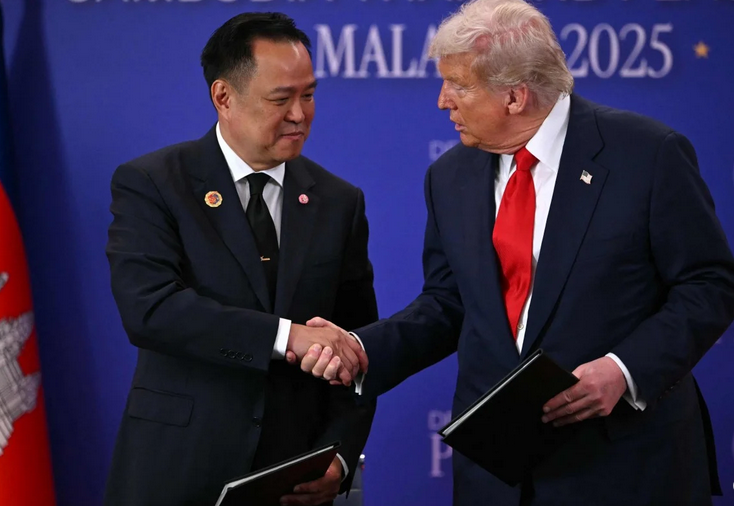
The US president views the Thai-Cambodia ceasefire deal as a ‘diplomatic trophy’ and will use trade leverage to protect it, analysts say
Thailand’s insistence trade negotiations with the US can proceed separately from talks over a fractious border dispute with Cambodia has been met with deep scepticism given Washington’s increasing use of economic policy as a political instrument and US President Donald Trump’s personal stake in the ceasefire deal.
Bangkok announced on Saturday that tariff talks with the United States would “remain separate from border issues”, a pledge government spokesman Siripong Angkasakulkiat said followed an assurance from Trump himself that Washington “does not wish to interfere”.
But this diplomatic calm was undercut by a letter from the Office of the US Trade Representative the Thai Foreign Ministry said it received just hours earlier, reportedly suspending negotiations until Thailand reaffirmed its commitment to the truce signed in Trump’s presence last month.
Tensions along Thailand-Cambodia border boil over as soldiers open fire
A bloody border conflict between Thailand and Cambodia erupted in July and tensions flared again last week after Bangkok accused Phnom Penh of injuring its soldiers by laying new landmines. Thailand subsequently suspended the peace deal the US president had personally helped to broker and demanded an apology.
Trump held separate calls with leaders of both countries on Friday. Neither the White House nor the US Trade Representative’s office have made public mention of the letter reportedly sent to Thailand suspending trade talks.
A framework trade pact the US and Thailand announced last month, retaining a 19 per cent tariff on Thai imports to the US while identifying areas for possible reductions, has yet to be finalised.
Analysts say it is “highly improbable” that trade and the border issue can be kept separate. Doing so would directly contradict Trump’s foreign-policy logic, according to Pavin Chachavalpongpun, a political scientist at Kyoto University’s Centre for Southeast Asian Studies.
“For this administration, economic access is not a distinct issue but a transactional lever used to enforce geopolitical compliance,” he told This Week in Asia.
“Tariff talks will remain indefinitely stalled or progress only minimally until Thailand makes a tangible, politically satisfactory gesture confirming its commitment to the security arrangement the US demands.”
Pavin suggested that Trump’s supposed stance on non-interference was largely performative, masking a policy of “calculated pressure” designed to secure American interests. “Trump views the ceasefire as a diplomatic trophy. His main concern is not non-interference, but ensuring the integrity of his personal political victory,” he said.
Prime Minister Anutin Charnvirakul, for his part, has used the moment to burnish his nationalist credentials ahead of a fast-approaching election, seeking a further reduction in US tariffs and adopting a hard line on Cambodia.
“By positioning himself as a defender of the country, he aims to strengthen his electoral support,” said Purawich Watanasukh, a political scientist at Thammasat University in Thailand.
“This explains the unusually tough rhetoric toward Cambodia and his assertiveness even when it appears to push back against the US.”
Purawich described trade and security as “inseparable” in Trump’s eyes, adding that this was “part of his strategy to project himself as a peacebuilder”.
Anutin, meanwhile, sees nationalism as a “card that plays in his favour” as he braces for a possible no confidence vote in December, according to defence studies lecturer Greg Raymond of the Australian National University’s Coral Bell School of Asia-Pacific Affairs.
The Thai prime minister’s tough rhetoric and emphasis on sovereignty were calibrated for domestic political gain, Raymond said, especially as his government faces scrutiny over ministers’ alleged links to a Cambodian scam-centre corruption scandal.
Pavin said the episode exposed the limits of Thailand’s so called bamboo diplomacy – a foreign policy strategy also employed by Vietnam that prioritises strategic flexibility and pragmatic compromise.
In recent months, Bangkok had “incurred maximum diplomatic cost” in its dealings with both Washington and Beijing, he said – pointing to politically driven concessions including the controversial deportation of 40 Uygur men to China and symbolic rice purchases to mark 50 years of Sino-Thai ties.
“This pattern, coupled with the inability to resolve the ceasefire issue, demonstrates a lack of the strategic subtlety required for successful balancing,” Pavin said.
“The abrupt cessation of tariff talks confirms that geopolitical alignment and domestic political signalling have dangerously destabilised the crucial long-term alliance with the US.”
-South China Morning Post-
