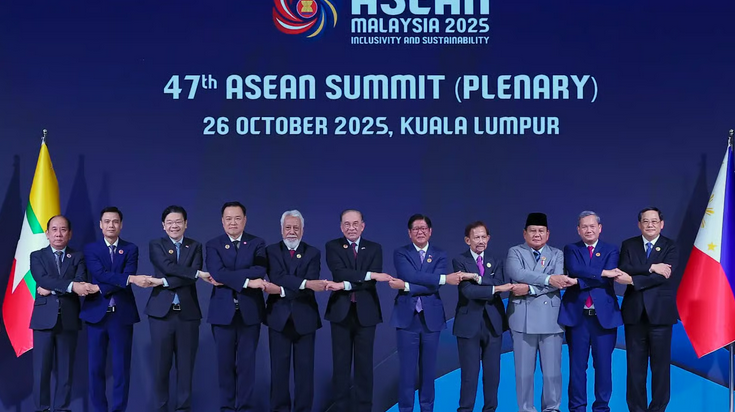
As armed clashes continue along the Cambodia–Thailand border, analysts are questioning the effectiveness and unity of the Association of Southeast Asian Nations in confronting one of the region’s most serious security crises in recent years.
Cambodian political scientist Kin Phea told KPT English that ASEAN members have remained largely passive despite the gravity of the conflict. “Due to their own national interests, ASEAN members do not dare to make any strong statement toward Thailand, which initiated attacks and continues its military actions against Cambodia,” he said, adding that calls for restraint have amounted to “meaningless statements without real action.”
A Weak and Fragmented ASEAN
Phea argued that ASEAN’s inability to respond decisively reflects structural weakness, describing the bloc as “weak, fragmented, and without a true sense of community.” He warned that inaction risks eroding ASEAN’s credibility at a time when regional cooperation is most needed.
“During this decade, ASEAN appears weak, fragmented, and without a true sense of community,” he said. “It struggles to solve regional issues, particularly when the problem involves its own member states. ASEAN no longer issues strong or effective statements, and this shows how broken the organization has become.”
Malaysia’s Mediation Efforts Praised
Despite ASEAN’s broader shortcomings, Phea praised Malaysian Prime Minister Anwar Ibrahim for active mediation, crediting his leadership with helping secure a temporary ceasefire and the signing of the Kuala Lumpur Peace Accord, witnessed by U.S. President Donald Trump.
“From the beginning of the armed clashes until the adoption of a ceasefire and the signing of the KL Peace Accord, Prime Minister Anwar has played a crucial role,” Phea said. But he cautioned that Malaysia cannot resolve the crisis alone, urging ASEAN to act collectively.
“This issue will be extremely difficult if other ASEAN members leave Prime Minister Anwar to handle mediation alone,” he added. “ASEAN must return to unity and act as one community with a shared future in addressing challenges and resolving conflicts together.”
Cambodia’s Need for Self‑Strengthening
Phea also emphasized that Cambodia must rely on its own national strength while pursuing diplomatic solutions. He argued that the conflict has exposed the limitations of external assistance during times of crisis.
“As we have seen during the armed clashes, nobody can truly help us,” he said. “Only our own strength and national capability can protect our sovereignty and resolve such issues.”
He stressed the importance of continuous development across all sectors, particularly the economy and national defense, to ensure Cambodia’s long‑term security and resilience. “We must strengthen ourselves,” Phea added.
ASEAN’s Relevance at Stake
Echoing similar concerns, Deth Sok Udom, a professor at Paragon International University, warned that ASEAN risks losing its relevance and raison d’être if it fails to engage meaningfully in the conflict.
“With each day that passes without ASEAN and its member states taking meaningful action, the organization is increasingly seen as ineffective,” Sok Udom told KPT English.
He clarified that ASEAN is not deliberately distancing itself from the issue, but rather lacks the institutional authority to intervene beyond the efforts of the ASEAN rotational chair.
“As I have argued consistently, ASEAN should be more actively supported and mandated to carry out monitoring and ceasefire enforcement, ideally with backing from the United Nations Security Council,” he said.
The Role of Major Powers
Sok Udom also highlighted the importance of major powers, particularly China and the United States, in shaping the trajectory of the conflict. He warned that unilateral pressure from Washington would be insufficient without corresponding cooperation from Beijing.
“U.S. pressure on Thailand will only be effective if it is matched by China’s genuine desire to see hostilities end, including behind‑the‑scenes mediation,” he said.
He cautioned that prolonging the conflict would be a lose‑lose scenario for both Cambodia and Thailand, weaken ASEAN centrality, and risk transforming a bilateral dispute into a broader regional proxy conflict amid U.S.–China rivalry.
Uncertainty Ahead as Malaysia’s Chairmanship Nears Its End
Sok Udom further noted that Malaysia’s ASEAN chairmanship is nearing its conclusion, raising questions about how the next chair, the Philippines, will position itself regarding the conflict. “How Manila chooses to approach this issue remains to be seen,” he said.
Ceasefire Claims and Continued Violence
Earlier in the week, facilitated by Prime Minister Anwar Ibrahim, U.S. President Donald Trump claimed that he could halt the fighting simply by speaking with both leaders.
After phone conversations with the Cambodian and Thai prime ministers on Friday night, Trump wrote on social media that both sides had agreed to an immediate ceasefire and to return to the agreement signed in front of him in October. “Both countries are ready for peace,” Trump wrote.
However, official statements from the two governments revealed conflicting positions. Cambodian Prime Minister Hun Manet welcomed an immediate ceasefire, while Thai Prime Minister Anutin stated that no ceasefire had been agreed upon.
Despite ceasefire claims, clashes reportedly continued along the border. A Special ASEAN Foreign Ministers’ Meeting, initially scheduled for December 16 to assess the situation, was postponed to December 22, according to Malaysia’s Ministry of Foreign Affairs.
“This allows us to ensure that everything is properly in place,” Prime Minister Anwar Ibrahim told the media, adding that Malaysia remains in daily virtual contact with both sides and continues to monitor the situation closely.
Civilian Casualties Rise
According to a report released by Cambodia’s Ministry of National Defence on December 17, Thai armed forces killed at least 17 civilians and injured nearly 100 others in what Cambodia described as indiscriminate attacks on border communities and cultural sites.
Lieutenant General Maly Socheata, spokesperson for the ministry, said the casualties resulted from shelling and airstrikes in Banteay Meanchey and Preah Vihear provinces early Wednesday, further escalating tensions despite the U.S.‑brokered ceasefire.
From:Kampuchea Thmey
